


Rwanda and Singapore have so much in common, especially the fact that both nations rely on human resource. Local leaders in Rwanda – which size is more than 30 times bigger than the Asian country, believe that there are even more opportunities in Rwanda.
Singapore is a country that achieved a fast and steady transformation two and a half decades after its independence in 1965.
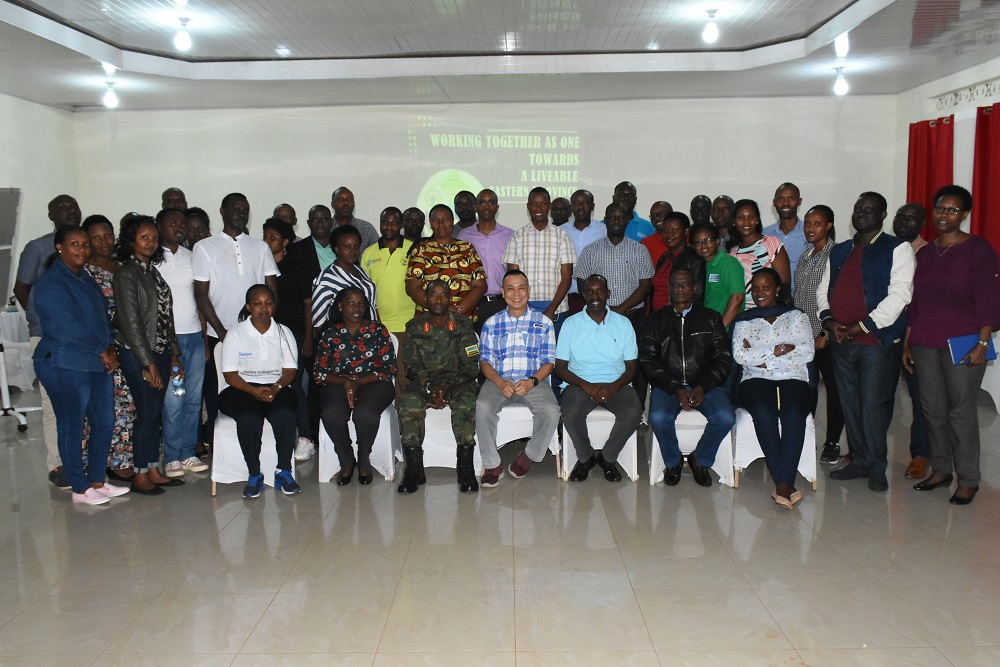
One of big days of 2019 for executive leaders of districts in Eastern Province and provincial staff is the one spent in a workshop facilitated by Shahrill Aj, Chief Transformational Facilitator at Nu Quest Management Pte Ltd from Singapore.
The Singaporean enlightened them about history and secrets of progress of his country.
Shahrill and his company have been in Rwanda since 2011, training and consulting for the Rwandan Government.
For the last eight years, he declared, it has been more on training, grooming and coaching future leaders and current leaders so that they can effectively execute their task.

Leadership key
Leadership is key to success of any organisation, team or country, according to Shahrill.
He mentioned: “You have a strong leader currently, just like what Singapore had in the past.”
However, if Rwanda is to keep its pace and make it like Singapore, Shahrill believes: “You have to think about who is next after His Excellency Kagame, and who will be the next leader, to ensure the continuity in his policies, in his plans and dreams.”
The facilitator also discussed about the role of building capacity for the civil service, also mentioning once works hard to achieve collective vision first, they easily and sustainably achieve their own goals.
“[In Rwanda] We have a group of dedicated and passionate leaders. Just a simple reminder is, going forward; do never lose sight of what they are in for. They are in to serve the people, to serve the community so they can make a difference, and that difference will lead to the changes, the transformation for the children today and the children of tomorrow,” he explained.
Having spent nearly a decade working in the country, transformation and progress have been happening in Shahrill’s eyes.
Following the day of training, Bugesera District Mayor, Richard Mutabazi, declared: “One often wants to change big things before changing small things that are close to us.”
“Among the simple techniques we have seen is assessing yourself and see if everything with you is proper before trying to change those next you,”, he reflected.
Eastern Province Governor, Fred Mufulukye, discussed that Singapore has a history that is quite similar to Rwanda’s; the two being smallest countries in their respective continents, with colonialization history as well.
“There came time people thought Rwanda would never be a country again, but ever since, where we are today is thanks to good leadership. While Singapore was founded on a leader like Li Kuan Yew, the Rwanda’s transformational journey has been led by President Paul Kagame,” he explained.
Patriotism, hard work and teamwork are the major values leaders need to strengthen, and to have in common to lift the citizens, Mufulukye pointed out.
“When you look back where we were 25 years ago, and see again where we are today, it is a sign that one day we can really be where Singapore is,” the Governor said, adding that Rwanda has more opportunities that the ones Singapore had in the start.
Singapore’s journey
Lee Kuan Yew, who died in 2015 aged 91, is seen as father of the great Asian nation, having been prime minister for three decades.
Shahrill illustrated: “If you are placed in the middle of a jungle, and nothing [of a help] is given to you, can you survive? Yes, you can. Because of the situation, human beings search for a way; because of hardships, you will think of how to survive, because you have nothing, you will find ways to get out of the difficult situation.”
He insisted that that was the case of Singapore; “Because of the survival need, that is why we have to work very hard for our success.”
In order to move forward, different measures were taken; for instance, the country that only relied on its people has had zero tolerance for corruption.
Ten years of education is compulsory.
“No child will be denied education regardless their family background. Parents have to send their child to school. If a parent does not send their child to school for no reason, they will go to court, and possibly to jail,” he revealed.
Every male adult Singaporean citizen is a qualified soldier, and no matter what other profession he has, he has to do national service in the army for three weeks every year.
During the Second World War, Singapore was surrendered by the British to the Japanese, but after the end of the war, the British retook control of the country until 1963. The country got independence on Aug. 9, 1965, after spending two years as part of Malaysia.
By 1990s, the country had already become one of the most prosperous nations in the world, with its top priority being industrialization and education.
Today, 95 percent of the Singaporeans own homes, according to Shahrill.
Shahrill said Singapore has one of the best airlines in the world, the best medical services in the region, and one of the best militaries in Asia.
“All our universities are in top 100 in the world. Our business college is in top three in the world too,” he stated.
Singapore is world business hub, although they have no natural resources, all top world oil & gas companies and financial institutions are found in the country.
On June 12, 2018, Singapore hosted a summit meeting between North Korean Chairman Kim Jong-un and U.S President Donald Trump, something seen as a success for Singapore.



A good author is always a good reader, you created
What the nation wishes for its citizens.